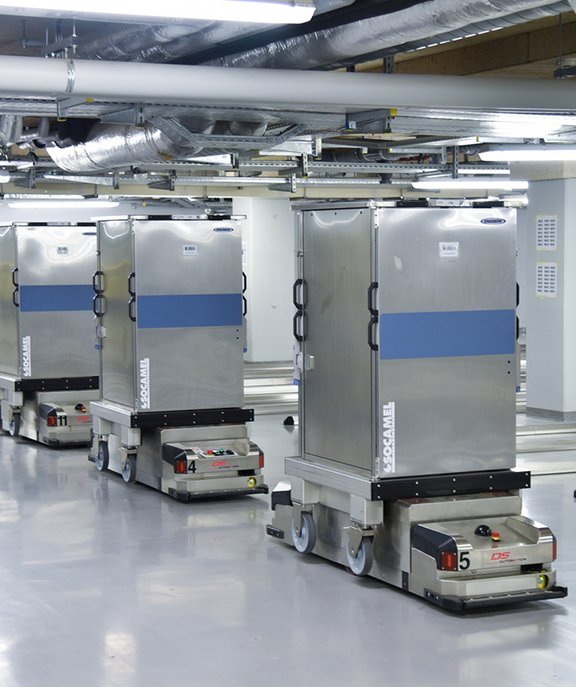

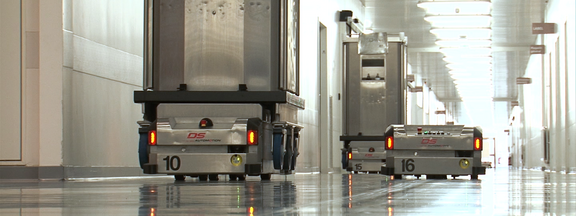
Well thought-out internal logistics in the healthcare sector
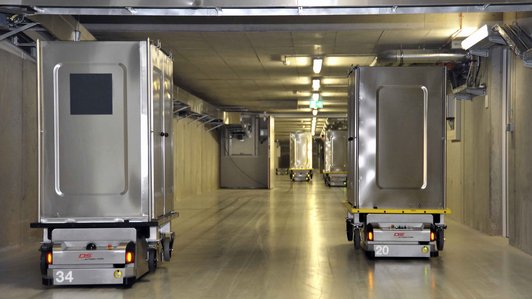
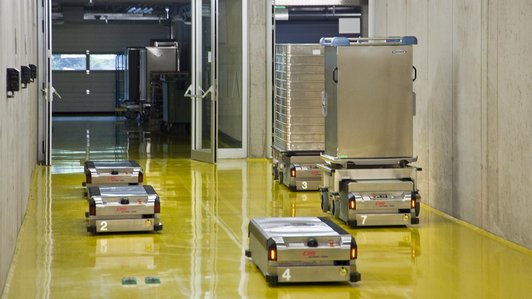
In order to increase the efficiency of goods transport in the medical sector, the use of driverless transport systems is recommended. This ensures that different goods such as food, medicines, medical accessories, material accessories, laundry, documents, waste and sterile goods are transported to various areas in the hospital without a driver when needed or at predefined times.
Compact vehicle for maximum hygiene
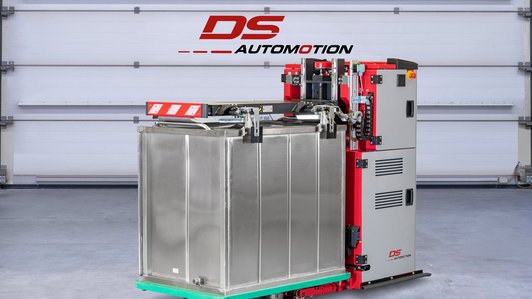
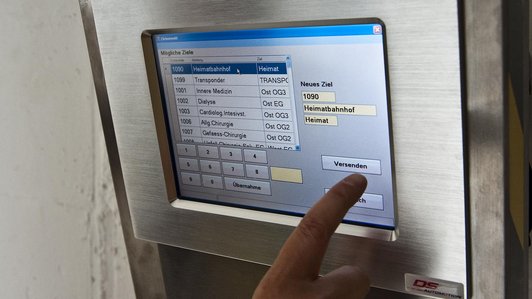
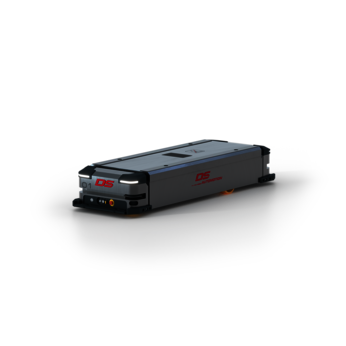
For efficient operation in hospital logistics, a smooth and automated process is essential. With CAREY, containers can be picked up from the goods distribution center and transported to the right places. With the help of our fleet manager NAVIOS, communication also works with gates, lifts and other peripheral equipment. In this way, our vehicles can also be navigated to different floors with the goods to be transported.
Benefits that move

Quality assurance through traceability of transports.

High security of supply to the stations due to the appropriate automation.

The use of automated goods transport optimizes the material flow in intralogistics and thus reduces the workload.

The 24-hour availability of the automated guided vehicles ensures a steady flow of materials without legal restrictions.
Future-proofing of the goods transport system by an experienced partner who will accompany you even after project completion.

Easy integration of third-party AGVs through VDA 5050





For me personally, it is important to make processes more flexible, reduce dependencies and cut costs on the basis of optimized processes and increased efficiency.

Interesting Facts About Container transport
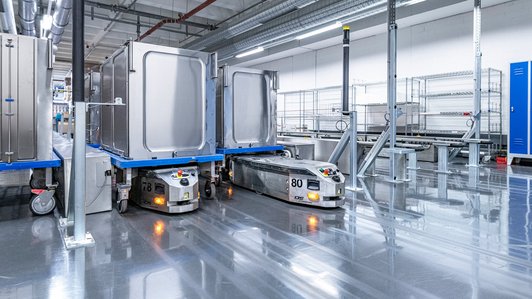
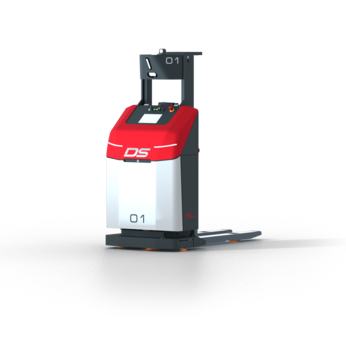
An automated guided vehicle drives underneath the roll container, lifts it and moves it to its destination without a driver. CAREY collects containers at the goods distribution centre and sets them down at the receiving point. The NAVIOS fleet manager assigns the order, plans the route and communicates with doors and lifts, so floor changes happen without staff involvement.
A pneumatic tube system moves small items through fixed tubes; an automated transport system moves whole roll containers along existing corridors. Tube systems are limited to what fits the carrier – typically documents, medication and laboratory samples – and the tube run has to be built into the structure. Container AGVs carry up to 500 kg per trip, including meals, laundry, waste and sterile goods.
ATS stands for automated transport system: the automated internal movement of goods within hospitals and other medical facilities. An ATS consists of the vehicles, the fleet manager and the interfaces to doors, lifts and higher-level systems. The German-language pages of DS Automotion use the equivalent abbreviation AWT, short for automatisierter Warentransport.
An automated guided vehicle, or AGV, is a driverless industrial vehicle that transports goods along a route assigned by a fleet manager. In hospitals it typically drives under a roll container, lifts it and delivers it to a ward. CAREY reaches up to 1.6 m/s and carries up to 500 kg. The VDA 5050 interface allows AGVs from different manufacturers to run in one fleet.
Food, medicines, medical accessories, material supplies, laundry, documents, waste and sterile goods are all transported automatically. They travel in standardised roll containers – the vehicle moves the container, not the individual item. Trips run either on demand or in fixed time windows, for example meal distribution at set times and laundry collection during the night shift.
Through an interface between the fleet manager and the building services. NAVIOS communicates directly with gates, lifts and other peripheral equipment: it calls the lift, sets the destination floor and releases it after the trip. Route planning covers several floors, so one transport can run from the goods distribution centre to the ward without any manual step.
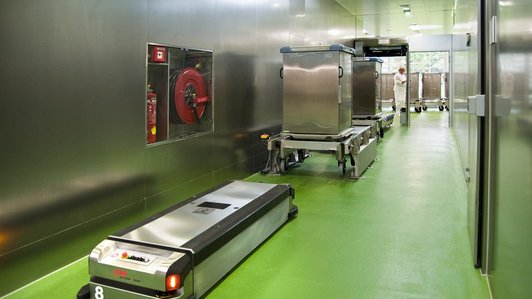
The CAREY system ensures the separation of vehicle and goods through its unique design. The vehicle's stainless steel cladding meets the hygiene and protection requirements of medical facilities, as it can be wet-cleaned and disinfected. The transported goods remain inside a closed container, isolated from the vehicle and protected from external influences throughout the entire transport process. This concept helps maintain the highest standards of cleanliness and contamination control in healthcare environments.
CAREY is protected by integrated laser scanners with a 180° protective field to the front and rear, with an optional foot guard. The scanners meet the standards for personal safety, and a voice output plus optical signalling draws attention to the vehicle where patients, visitors and staff move freely. The vehicle stops when the scanner detects an obstacle in its protective field.
Yes, through the VDA 5050 interface. NAVIOS integrates VDA 5050 in full, and DS Automotion contributes to the development of the standard. An existing installation can therefore be extended with compatible third-party vehicles without replacing the fleet manager. For higher-level systems, OPC UA, Modbus TCP, ProfiNet, MQTT and a REST API are available.