Autonomous Transport Systems Accelerate Materials Testing at voestalpine Stahl GmbH
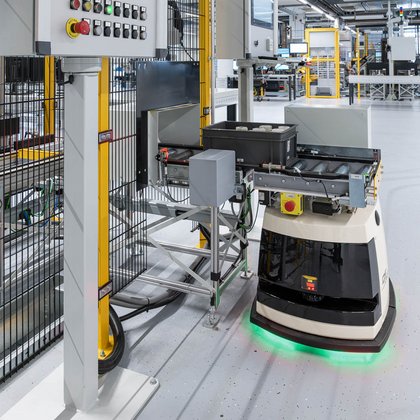
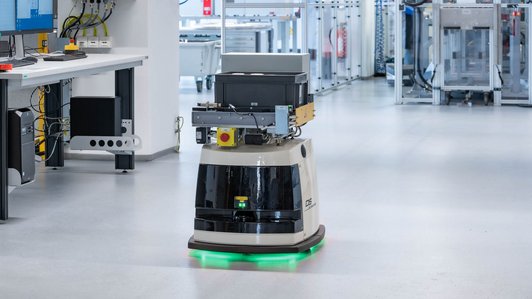
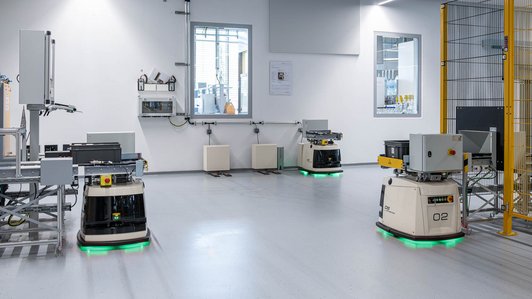
Three mobile robots from DS AUTOMOTION handle sample transportation at the testing center of voestalpine Stahl GmbH. What initially appears to be a minor automation task has transformed the entire process: samples are continuously delivered to the next work station, waiting times are reduced, and test results become available significantly faster.
Share article
A single steel sample is ready for testing and is automatically transported to the appropriate testing station by a mobile robot from DS AUTOMOTION. While this may sound like a routine operation, it has a significant impact on processes at the voestalpine Stahl GmbH testing center in Linz. Following several years of planning and implementation, the facility entered full operation in early 2025 and is regarded as one of the most advanced steel testing centers in the world. Covering 4,300 m² across two floors, the center brings together all quality-relevant testing processes for the cold-rolled steel division under one roof. The scale of operations is reflected in its 59 test methods, 117 different sample geometries, and approximately 150 testing and production systems. Around 85,000 tests are carried out each month within the testing center, with another 100,000 conducted directly on production lines. A key objective during the facility's design was to establish a fully digitalized and automated process chain.
From Manual Transport to Continuous Flow
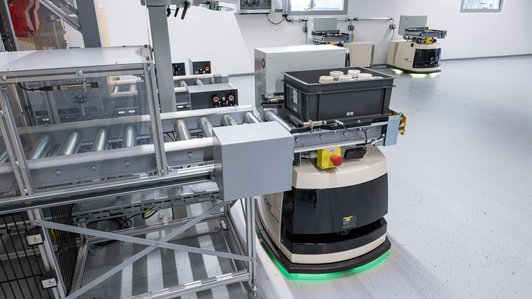
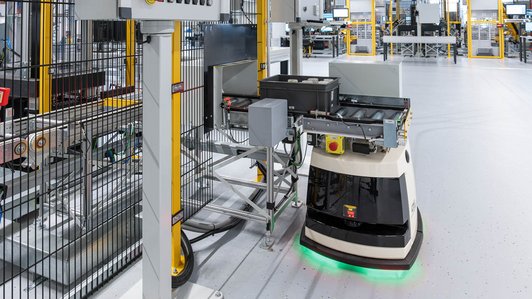
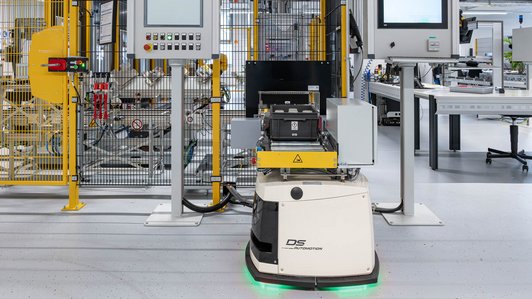
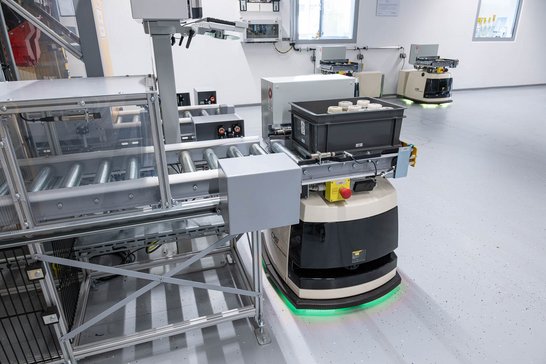
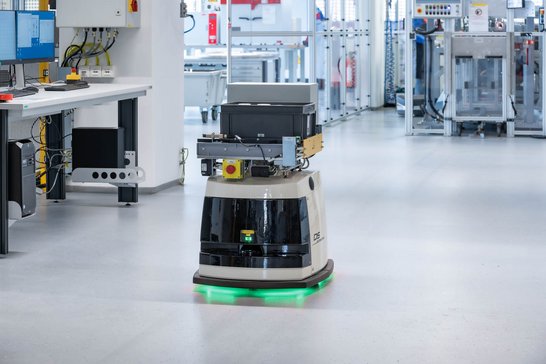
Before automation was introduced, employees transported sample containers between individual workstations. Today, this task is performed by three SALLY autonomous guided vehicles from DS AUTOMOTION, a leading expert in mobile robotics. Their introduction changed more than just transportation. It fundamentally altered the way work is organized within the testing center. Previously, operations followed a traditional batch-processing approach: samples were collected and only forwarded once a predetermined quantity had accumulated. Subsequent process steps would not begin until sufficient samples were available. Today, the transport vehicles operate continuously. Although the specially developed transport box can accommodate up to 14 test specimens, it no longer has to be full before being moved. When required, even an individual sample is delivered immediately to the next station. "One of the most exciting aspects of this project is that autonomous transport appears to be only a small part of the overall testing process at first glance. In practice, however, it makes a major contribution to improving efficiency and accelerating workflows," says Michél Pühringer, Project Manager at DS AUTOMOTION.
Speed Over Batch Size
In materials testing, time is a critical factor. The testing center does not produce physical products in the traditional sense; it generates measurement data. The faster this data becomes available, the faster other departments can react. This is particularly important during the introduction of new products and the optimization of manufacturing processes. Success is measured not by the number of samples processed together, but by how quickly the result of an individual test becomes available. The continuous flow of materials eliminates the need to wait for larger sample batches. As a result, turnaround times have been significantly reduced. While some tests previously required several days to complete, most are now finished in less than eight hours. At the start of the project, it was by no means obvious that automated transportation would contribute so significantly to this improvement.
Three SALLY Vehicles for the Last Mile
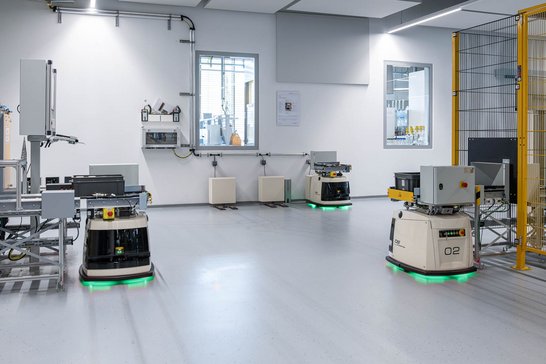
SALLY is particularly suited for transport tasks covering the "last mile" between individual process stations. While the vehicle is capable of carrying loads of up to 100 kilograms, payloads in this application are limited to a maximum of 15 kilograms. The lower section of the vehicle is based on a standard DS AUTOMOTION product, while the upper structure was specifically adapted to meet the requirements of the testing center. Approximately 140 magnetic markers form the basis of the navigation system throughout the facility.
The mobile robots follow predefined routes but can deviate slightly to the left or right within a defined corridor. This flexibility enables minor position corrections, for example when a vehicle is slightly too close to or too far from its intended stopping point. The safety scanners required for personnel protection are also used for localization. The reliability of the vehicles in day-to-day operation has positively surprised the testing center team. They require very little attention and perform their tasks largely in the background.
For Pühringer, this is one of the most important requirements for industrial AGV solutions: "The purpose of an automated system is not to keep operators constantly occupied with it. A good solution is one that operates independently and delivers the required level of availability." Safety performance has also been impressive. At voestalpine Stahl GmbH, even near-miss incidents must be reported. To date, no such reports have been associated with the autonomous transport vehicles.
More Than Just Vehicles
Achieving this level of performance requires more than a reliable vehicle. Behind the visible transport movements lies sophisticated logic that connects transport orders, routes, and process workflows. For DS AUTOMOTION, a significant part of its expertise therefore lies in system integration. "Even the best vehicle is of limited value if the underlying logic does not fit the process," explains Pühringer. "That is why we see ourselves as a system integrator rather than simply a vehicle supplier. The key is understanding together with the customer what the system actually needs to achieve and then developing the most suitable overall solution." This applies not only to the technical design of the system but also to its interaction with the realities of day-to-day operations. Rather than implementing a standalone solution under idealized conditions, both the vehicles and the control logic are adapted to the actual process environment. In demanding industrial applications, experience and close collaboration between supplier and customer remain essential.
Working Together to Find the Right Solution
Both parties regard their close cooperation as one of the key success factors of the project. Requirements and deviations were discussed openly, challenges were analyzed jointly, and solutions were developed collaboratively. For DS AUTOMOTION, responsibility does not end with commissioning. "We don't simply install a system and walk away," emphasizes Pühringer. “We continue supporting our customers afterward. When issues arise, we analyze them together and develop improvements collaboratively. This open and transparent exchange builds trust over the course of a project.”As a result, the team at voestalpine Stahl GmbH is convinced that, should future requirements for autonomous transport systems arise, DS AUTOMOTION would once again be their partner of choice.
„The logistics solution for the voestalpine Steel Division was an exciting project with numerous challenges. I am proud to have been part of this project and to have supported its successful implementation."