

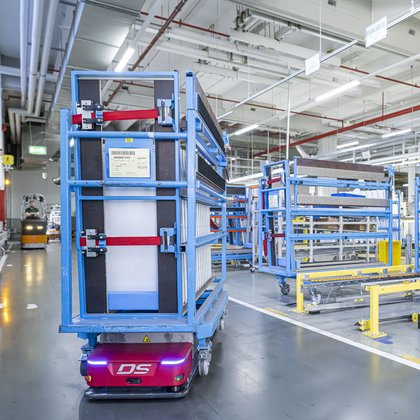
In the BSH Hausgeräte production facility in Giengen an der Brenz in Southern Germany, refrigerator and freezer doors travel quite a distance to where they are fitted to the cabinets. Their manual transport left an automation gap within the appliances’ assembly. Now an automated AGV system designed and installed by DS AUTOMOTION provides fully automatic, demand-driven door transport. Its OSCAR spin tunnel AGVs take the carriers piggyback to haul them from door assembly to the final assembly lines. This set former transport workers free for more rewarding tasks. With guaranteed on-time delivery, a reduced accident rate and in-creased energy efficiency, it also contributes to a frictionless and sustainable home appliances production.
Share article
BSH Hausgeräte used DS AUTOMOTION AGV system to close Automation Gap: Cool Door Transport
Few things have changed everyday life as much as refrigerators and freezers. They enabled consumers to stock day-to-day consumer products and enjoy even delicate foods as good as fresh at a later point in time, even outside of their short harvest seasons. This changed shopping habits. Less time-consuming shopping trips at longer intervals did a lot to ease work and family reconciliation.
Refrigeration Expertise
BSH Hausgeräte GmbH (BSH), a company within the Bosch Group with around 62,000 employees, is the Europe’s biggest manufacturer, producing a complete range of modern home appliances in 40 factories around the globe. In Giengen an der Brenz, Germany, BSH has been designing and manufacturing leading-edge refrigeration appliances for more than 70 years. The 2,750 employees working in the refrigeration appliances competence center there design and produce 1.5 million refrigerators and freezers per year.
BSH embraces the manufacturing methods of Industry 4.0. The cabinets and doors are produced to order in often very small batches. The refrigerator and freezer production lines at BSH’s Giengen plant fulfill all requirements of a modern, net-zero production.
Cabinet needs Door
Each production line is comprised of two assembly lines, one for the doors and one for final assembly. The assembly lines for the refrigerator, freezer and combined fridge-freezer cabinets with the refrigeration units are located apart from the two door assembly lines. There, the doors are completed with plastic interior paneling and an insulating polyurethane core as well as a door seal. Like the refrigerators and freezers, the doors come in different sizes for one and two door, single and double winged models. In each of these lines, BSH produces about 600 doors per shift. These needed to be transported several hundred meters to their matching cabinets.
While the upstream and downstream processes were already highly automated, BSH workers transported the doors in transport cradles using side seat stackers. “This mode of transport came with certain drawbacks, binding employees badly needed for other tasks”, says Steffen Baur, Intralogistics planner at BSH. “We therefore decided to close this automation gap.”
The decisive factor for placing the order was the knowledge of the reliability and availability of the systems from Austria, which we gained on the occasion of a reference visit to a large dairy plant.

Two AGVs in one
The local situation, particularly the restricted space at the loading and unloading stations, did nothing to make this this task easier. Prior to writing a requirement specification, BSH used supporting services of an external consultant to conduct extensive preliminary studies and analyses. When autonomous guided vehicles (AGVs) had been agreed upon as the method of choice, BSH sent a request for tender to a number of well-established AGV manufacturers.
During the tendering procedure, the wheat was quickly separated from the chaff. “We had taken three manufacturers into consideration. DS AUTOMOTION demonstrated their superior competence early, providing the most serious proposal”, Steffen Baur recalls.
“The insights on the high reliability and availability of the Systems made in Austria we gained during a visit in a large dairy plant were decisive for awarding this contract.”
DS AUTOMOTION has been solely designing and manufacturing AGV systems for nearly 40 years and was able to harness this experience in the BSH project. The exp0erts created a comprehensive system connecting both lines in a shared circuit. This ensures the best possible combination of economical and flexible AGV utilization.
On-demand Transport
One type of door per load, workers stack refrigerator and freezer doors into the carriers at the end of the door assembly lines. Upon transportation to the assigned final assembly line, they are removed by workers in one of the stations and by an industrial robot in the other for processing. The carriers are then shunted to an empty return position.
The waiting positions for the full carriers are equipped with presence sensors. If and when a final assembly line requires doors and a carrier is ready to be picked up at the assigned door assembly line, the NAVIOS fleet management software automatically creates a transport order. It commissions the AGV that is most favorably positioned to fulfill the order using the most efficient route.
Sensors are also used to monitor the empty return positions at the final assembly lines. NAVIOS automatically also includes empty return transports in its order processing. Occasionally, not all of the doors in a carrier are immediately processes. Therefore, filling level sensors at the empty return positions monitor the carriers. NAVIOS directs those that are not completely empty to specific discharging positions at the door assembly lines.
As the AGVs in four places move through fire doors, DS AUTOMOTION linked NAVIOS with BSH’s central fire alarm system. They also integrated several hazard lights and a traffic light.
The OSCAR series of FTFs can navigate contour-based (SLAM) via KBL technology without the need for specially installed landmarks.

Mit Sicherheit von A nach B
Durchgeführt werden diese Transporte von acht Unterfahr-FTF der Baureihe OSCAR von DS AUTOMOTION. Diese transportieren huckepack die Ladungsträger. Bei diesen handelt es sich um standardisierte Trolleys, die anlässlich der Automatisierung des Türtransportes angeschafft wurden. Darin werden die Türen je nach Höhe in ein oder zwei Ebenen stehend transportiert, angelehnt an Querstreben.
Damit es auch bei abrupten Bremsvorgängen nicht zu Lageveränderungen kommt, erfolgt der Transport immer diesen Streben voraus. An den Stationen werden die Trolleys andererseits mit den Türen voraus positioniert, sodass die Werker bzw. der Roboter diese besser be- und entladen können. Deshalb und weil die Be- und Entladepositionen quer zur Fahrtrichtung an den teilweise recht engen Gängen angeordnet sind, fiel die Wahl auf den Typ OSCAR spin, da dieser am Stand drehen und sehr enge Kurven fahren kann.„Die FTF der Baureihe OSCAR können ohne eigens installierte Landmarken konturbasiert (SLAM) per KBL-Technologie navigieren“, erläutert Karl Rapp, Bereichsleitung Vertrieb, Produktmanagement und Marketing bei DS AUTOMOTION. „Für höhere Präzision in den Bereichen wurden zusätzlich Magnetpunkte im Boden installiert, welche im Layout exakt vermessen wurden.
“Sie befahren Gänge, die nicht eigens für den FTF-Verkehr präpariert wurden. Seine robuste Konstruktion mit 25 mm Bodenfreiheit und ein solides Antriebskonzept verleihen OSCAR die kompromisslose Industrietauglichkeit und Langlebigkeit auch im Betrieb auf unebenen Hallenböden.
Die Gänge müssen sich die FTF mit verschiedenen anderen Verkehrsteilnehmern teilen. Zu diesen gehören Fußgänger mit und ohne Hubwagen ebenso wie bemannte Stapler oder Milkrun-Routenzüge sowie Radfahrer. Der Kommunikation mit dem Umfeld dienen nahtlos im Gehäuse eingelassene LED-Leuchten. Sie sorgen ebenso wie ein farbiges Bodenlicht für die nötige Aufmerksamkeit der anderen Verkehrsteilnehmer.
Für deren Sicherheit sorgen in den bis zu 1,2 m/s schnell verkehrenden FTF integrierte Sicherheits-Laserscanner mit 2 x 180 ° Blickwinkel und Trittschutzleisten für Bereiche, in denen die Schutzfelder deaktiviert werden müssen. Je eine TOF-Kamera vorne und hinten erweitert den Sichtbereich in die dritte Dimension, um auch Kollisionen mit Hindernissen zuverlässig zu vermeiden, die nicht bis zum Boden reichen, etwa von Staplern angehobene Lasten oder Routenzüge.
Innovatives Warte- und Ladekonzept
Die Ladung der integrierten Batterien erfolgt im Fahrzeug über Bodenkontakte. Diese sind an einer der Endmontagelinien in einige der FTF-Wartepositionen integriert, sodass der Ladevorgang ohne weiteren Zeitbedarf erfolgen kann. An einer der Türmontagelinien ist reichlich Platz für die Bereitstellung der vollen Trolleys vorhanden, an der anderen nicht. Um den Verkehr im Gang nicht durch wartende Fahrzeuge zu blockieren, wurde bei dieser jenseits des Ganges ein Wartebereich eingerichtet. Auch dessen Plätze dienen zugleich der Batterieladung. So muss nur in seltenen Ausnahmefällen ein FTF mit niedrigem Batterieladestand dem automatisierten Transport entzogen werden, um zu einer Ladestation zu fahren.
„Die Anlage von DS AUTOMOTION ermöglichte uns die vollständige Automatisierung des Türtransportes innerhalb von zwei Kühl- und Gefrierschranklinien“, resümiert Steffen Baur. „Mit bemerkenswerter Kompetenz und Erfahrung meisterte das Unternehmen unsere Herausforderungen und führte das System über mehrere Optimierungsschritte zum Erfolg.“